How to play session in cricket betting: the run line, the gap and the khadda
A session is a bet on how many runs a batting side scores in a set stretch of an innings — the first six overs, the first ten, overs eleven to fifteen. It settles as soon as that stretch ends, which is why it is the busiest market during a T20.
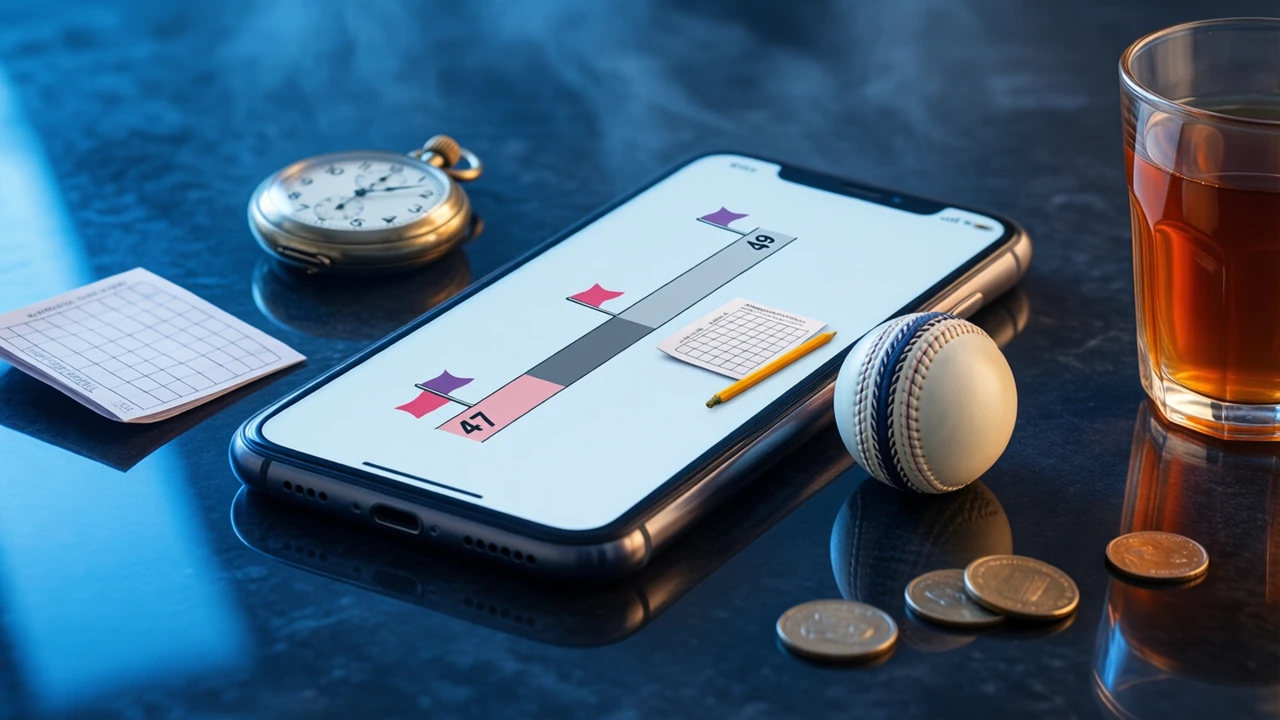
It uses the same two-sided logic as back and lay, but instead of two prices on one team you get two run figures on one stretch.
Mid-match, two prices on screen
What a session quote shows
A typical line for the first six overs reads No 47 · Yes 49, often with a small number such as 100 under each.
- No 47 — you win if the side scores fewer than 47 in those overs.
- Yes 49 — you win if it scores 49 or more.
- 100 — the rate. At 100, a ₹100 bet wins ₹100. What happens when that number is not 100 is covered on the fancy and run bhav page.
Mid-match, two prices on screen
The gap where both sides lose
Look at 47 and 48. Neither side wins on them: 47 is not fewer than 47, and 48 is not 49 or more.
| runs in the six overs | No 47 | Yes 49 |
|---|---|---|
| 44 | wins | loses |
| 46 | wins | loses |
| 47 | loses | loses |
| 48 | loses | loses |
| 49 | loses | wins |
| 55 | loses | wins |
That band of two runs is how the market is paid. The wider the gap between the No and Yes figures, the more outcomes belong to the house. A line quoted No 48 · Yes 48 would have no gap at all — you will rarely see one.
Mid-match, two prices on screen
How the line moves during the session
The figures are not fixed. After every ball the line is re-set: a four in the second over lifts both numbers, a wicket drops them. The market also stops taking bets for a moment on a wicket, a boundary or a third-umpire check, and comes back at the new level. If you tap during that moment, the bet is simply not accepted.
A line that has moved is not a better line. It is today's estimate. Your bet is settled against the figure you took, whatever the line says later.
Mid-match, two prices on screen
The khadda: when a moving line pays twice
Here is the reason people follow a session over by over. Suppose you take Yes 45 at 100 in the third over. Two overs later, a flurry of boundaries moves the line and you take No 52 at 100. Now look at every possible finish:
| runs at the end | Yes 45 (₹100) | No 52 (₹100) | total |
|---|---|---|---|
| 44 or fewer | −₹100 | +₹100 | ₹0 |
| 45 to 51 | +₹100 | +₹100 | +₹200 |
| 52 or more | +₹100 | −₹100 | ₹0 |
Whatever happens, you do not lose — and if the score lands anywhere between 45 and 51, both bets win. Bettors call that a khadda, a pit the score falls into. It only exists because the line moved between your two bets. Be careful with the word itself: on some apps khado is also the name of a separate market on the runs in a single over.
The same table shows the catch. The khadda needed the line to move seven runs your way first. When it moves against you instead, the second bet is a loss cut, not a pit.
Mid-match, two prices on screen
Session rules worth reading before the first ball
- Which overs, exactly. "6 over runs" counts runs off the first six overs, including extras.
- What if the innings ends early. If the side is bowled out before the stretch ends, most rules settle on the runs scored. Check how your market treats it.
- What if rain cuts the match. A session whose overs are never bowled is usually void. One that was completed before the rain usually stands.
- Which side is batting. Sessions exist for both innings; the first-innings line and the chase line are different markets.
Mid-match, two prices on screen
Can you win session betting?
Only by being right more often than the gap allows. At a rate of 100 a win pays exactly what a loss costs, so the gap decides everything: every finish that lands inside it is a loss for you whichever side you took. Picking No or Yes by guesswork therefore loses slowly, session after session. Nobody can promise a session method that beats that. What you can do is know the gap before you bet, and know that a khadda is something the line gives you, not something you can plan.
Mid-match, two prices on screen
Before you take a session line
- I can say which figure wins for No and which for Yes.
- I have counted the runs in the gap between them.
- I know the rate under the figure and what ₹100 returns at it.
- I know what happens to this session if the innings ends or it rains.
- I have not taken a second bet only because the first one is losing.
FAQ
What is session in cricket betting?
A bet on the number of runs scored in a set stretch of overs, taken as Yes (at or above a figure) or No (below a figure).
Why did both Yes and No lose?
The score finished in the gap between the two figures — for example 47 or 48 on a No 47 / Yes 49 line.
What is a khadda in session betting?
Holding Yes at a lower figure and No at a higher one, taken at different moments. If the score finishes between them, both bets win.
Does a session count if it rains?
Usually not if its overs were never bowled; usually yes if they were completed. The market's own rules decide.